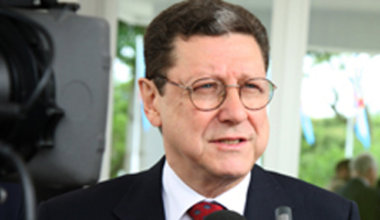
Kinshasa June 20, 2009 - The commander of MONUC Forces, General Babacar Gaye, gives his impression of the evolution of military operations in the framework of the Kimia II campaign against the FDLR, on the protection of the civilian populations, as well as on relations between MONUC and FARDC. INTERVIEW.
General, what assessment have you taken away from your recent visit to North and South Kivu?
This was a visit following on the one by the SRSG and the Defense Minister to Bukavu and Goma. It was intended as a follow-up on questions raised and decisions taken. Where are we now?
The first concern is the joint operations character of Kimia II. We elaborated a number of documents that set out the framework of this joint operation. It is essential that these documents be applied to the letter because this is what allows us to concentrate us on our task which is the protection of the civil populations. It is important to underline that the FARDC has incorporated the protection of the civilians as one of their priorities. They have also frankly laid out the problems of discipline they are facing.
There is a second source of concern. We must make every effort to avoid collateral damage as a result of operation Kimia II. The question is, what plans we will develop to sustain an outcome that is already satisfactory, and I will tell you by way of comparison that since the start of Kimia II, three months ago, we have repatriated some1250 ex-combatants, which was the total number of repatriations during 2008, it is therefore about sustaining this rate.
Recently there have been confrontations between the FARDC and MONUC troops, what is your impression?
There were last week, what I would call, something like "mood swings" of the soldiers, due to the delay in the payment of their salaries in Rutshuru and in Walikale, this also resulted in a confrontation between our elements in Pinga and some uncontrolled elements of the FARDC. General Amuli, [FARDC] Chief of operations of Kimia II, went there, to appeal to the troops and restore cohesion and discipline, but it still necessary that salaries be paid on time.
You know, when operations carry on for so long, when soldiers are far from their families for a long period, when logistical support is lacking, all of this creates discipline problems. It becomes still more complicated when there are a lot of new elements integrated without having received the instruction necessary to create cohesion.
Does MONUC manage or supervise payment of the FARDC?
MONUC supports the FARDC in several areas but with regard to the payment of the soldiers the international community helps the Congolese government through EUSEC. They conducted a biometric census of troops in order to control resources better and they were also trying to improve the payment chain but, again, the money has to be there.
The integration process happened quickly, and not everybody was included in the payroll. In short, administration must be improved in order to meet the demands of an army conducting operations.
Taking count he FARDC situation, the limits of the MONUC, notably the aerial support, and the sufferings of the population, it is possible to consider a new strategy to eliminate the threat of the FDLR?
This is the moment for an evaluation of Kimia II campaign and that was the purpose of the recent visit of the Special Representative and the Defense Minister to Bukavu and Goma. What is the situation on the ground?
When you see the results of the struggle against the LRA in Haut Uélé where MONUC is supporting the Republican Guard battalion that operates together with a very highly regarded army like Uganda’s, there are results. That is to say that there are minimal conditions that must be created. It is necessary that the FARDC have a minimum of equipment and that their salary be paid regularly, this is apparently the case with the Republican Guard. FARDC has to be well directed by effective commanders, as we have with the Republican Guard. These are some of the conditions that must be created in the Kivus if one wants improve the effectiveness of the FARDC.
As for air assets, this is a fundamental question. If one takes into account the lack of an acceptable road network in the Kivus, it is clear that aerial cover must be a given. In this regard, we have authorization for 18 helicopters which we are still awaiting in order to sustain the FARDC better, but it would be desirable that the FARDC themselves have helicopters. This would allow them to deliver food to their men which would be excellent for the moral, and would prevent them from using the local population to transport their food and kit. It would also allow them more flexibility in their manœuvres, to surprise the FDLR and to cut off their withdrawal.
How do you assess the protection of civilians at the present stage of operations?
For us it is the most important question, because the Security Council placed the protection of the civilians at the heart of our mandate and it is therefore our priority task. We are proceeding within the limits of our capacities and where we are deployed. The Council has acknowledged that there are limits to our action. Today, what is the situation?
The situation is a concern to all international actors who follow this crisis and that support this population. They are concerned first because these operations, as was feared, have created new population displacements, but especially because unfortunately these operations are accompanied by collateral damage that arise from the fact that some FARDC soldiers, who are, without doubt, insufficiently controlled and kept in line. The FARDC has realized this and I must say that there have been important efforts in that direction. I would cite the example of what happened in Pinga, where some FARDC fired on a MONUC base. It is worth noting that 11 soldiers, including 2 officers, have been arrested. There is, therefore, an awareness on the part of the FARDC hierarchy that these acts of insubordination should not tarnish the efforts being made by the vast majority of the FARDC.
It is not enough to denounce the behavior of the FARDC, it is necessary that everybody contribute towards managing this problem. For MONUC, protection of civilians is not only in the hands of the soldiers, all substantive sections of the Mission participate. We have put in place Joint Protection Teams in which you will find humanitarian actors, child protection specialists, human rights and other sections. These teams serve as an interface between [MONUC] troops and the civil population. We have multiplied our deployments, within the limits of our capacity. We are also ready to support the FARDC in everything aspect of Military Police and the application of justice. In this regard we should note and congratulate the FARDC for putting in place an operational Court Martial in the field to judge cases immediately as they appear.
Kimia II is a military campaign, should we expect that the actions will be spread over several weeks, or even months?
Everything will depend on the results. The objective set for operation Kimia II is to neutralize the FDLR, that means succeeding in the repatriation of some 2,500 FDLR in North Kivu and about 3,500 in South Kivu, but it is clear that the operation must not become bogged down because this would have consequences in terms of suffering of the population and because the military option must be decisive even though we must recognize that in this campaign there will be no decisive battle. Wherever operations have been launched, as a general rule the FDLR has avoided confrontation, but while making life increasingly difficult, cutting off their sources of revenue, while trying to disrupt their command structure, we will certainly create conditions in which there will be more and more volunteers for repatriation and defection..
How long will it take? It’s difficult to say and that was one of the objectives of this assessment I mentioned earlier. We have planned a new assessment of the situation during the month of July.
Do you have any news on the arrival of the 3,000 new Blue Helmets?
It is a question that we are following very closely. It is a matter on which our Headquarters in New York is very active. Today, the situation on the field absolutely requires the arrival of these reinforcements. There is an enormous amount to do to protect the population and we are eagerly awaiting the arrival of our colleagues from Bangladesh and Egypt that will constitute this force.